
Best Practices for Meeting People from Classifieds
Meeting people from classifieds can be safe and effective if you follow key precautions. Classifieds platforms like SeekingList offer a straightforward way to connect with others, but safety and preparation are essential. Here's what you need to know:
- Verify Profiles: Look for detailed bios, multiple photos, and verification badges. Use tools like reverse image search or video chat to confirm identities.
- Stay Safe Online: Keep communication on the platform, use private email relay systems, and avoid sharing personal details too soon.
- Spot Red Flags: Be cautious of financial requests, overly intimate behavior early on, or refusal to meet in public.
- Choose Public Meeting Spots: Opt for busy, well-lit locations like coffee shops or hotel lounges. Avoid private or secluded areas.
- Plan Ahead: Share your plans with a trusted friend, arrange your own transportation, and trust your instincts.
SeekingList stands out with features like anonymous messaging, AI moderation, and ID verification, making it a safer option compared to alternatives like DoubleList or Reddit r4r. Always prioritize your safety and take control of your interactions.
Checking Profiles and Building Trust
Before meeting someone from a classified ad platform, it's crucial to verify their identity. Start by evaluating their profile. Genuine users usually have detailed "About Me" sections that outline their interests and intentions. Profiles with vague descriptions or just a few words often signal bots or users who haven't put much effort into their accounts. Pay attention to the photos as well - authentic profiles typically include a mix of headshots, full-body shots, and casual images. Be skeptical of profiles with only one photo, especially if it's blurry or looks like a stock image.
Verification badges are another important tool. Platforms like SeekingList offer features such as ID verification and "Selfie Liveness Verification", where AI analyzes facial movements, like blinking, to confirm the person is real.
You can also take extra steps like running a reverse image search with tools like Google Lens to see if the profile picture appears on stock photo sites or other social media platforms. Requesting a video chat through the platform is another effective way to confirm someone's identity. As the Seeking Blog (SeekingList) points out:
If the person on the other end isn't willing to show their face on the computer, you better bet he or she has something to hide.
Initially, keep all communication within the platform. For example, SeekingList uses a private email relay system to protect your contact information while you get to know someone. These steps help build trust before moving on to in-person meetings and mirror the robust safety measures offered by SeekingList to ensure secure interactions.
Steps to Verify Someone's Profile
Once you've reviewed the basics of a profile, dig a little deeper to confirm consistency. Conduct a quick online search to check for any public discrepancies. Pay attention to whether the lifestyle shown in their photos matches the details in their bio. For instance, if someone claims to be a college student but their photos suggest a completely different story, that's a red flag. Another thing to watch for is "mirroring", where someone seems to perfectly align with your interests as a tactic to gain your trust.
When sharing photos, protect your privacy by sending a screenshot of the image instead of the original file. Original photos often contain metadata, like geo-tags, that can reveal your location. Additionally, using SeekingList's private email relay system keeps your personal email address hidden until you're ready to share it. Once you've verified the profile details, stay alert for any behavioral warning signs.
Warning Signs of Fake or Dangerous Profiles
Even after thorough checks, some behaviors should raise immediate concern. Financial requests are a major red flag. If someone asks for money, gift cards, banking details, or pitches "investment opportunities", they may be running a scam. Other red flags include the use of overly intimate pet names like "sweetie" or "baby" right away, or sudden declarations of love early in the conversation. These tactics, known as "love bombing", are designed to manipulate your emotions and lower your defenses.
Behavioral inconsistencies are another warning sign. If someone repeatedly avoids video calls or in-person meetings, they might be hiding something. Similarly, users who push for private, secluded meetings or try to move conversations off-platform may be trying to avoid moderation. As the Seeking Blog (SeekingList) warns:
If your date's profile disappears from the platform before you meet, it could be a sign of someone who doesn't want to be tracked.
Lastly, never click on external links sent through messages, as these could lead to phishing scams or malware. Spotting these red flags, paired with setting boundaries and choosing safe meeting locations, can help you navigate interactions confidently and securely.
sbb-itb-47dd745
Communicating Boundaries and Expectations
Once you've confirmed a profile's legitimacy, the next step is establishing clear communication about your needs. Being upfront about your goals and limits not only protects your safety but also ensures you're connecting with people who share your intentions. This approach minimizes misunderstandings, saves time, and reduces the chances of awkward encounters.
State Your Goals from the Start
Transparency is key. Use the "About Me" section of your profile to outline your interests and intentions while keeping personal details private. When conversations begin, be direct about what you're looking for - whether it's something casual, a long-term connection, or simply exploring possibilities. As Seeking.com puts it:
Honesty and open communication have always been our core principles.
This level of openness helps establish mutual understanding and ensures you're not compromising on what matters to you.
Before meeting in person, agree on the practicalities like the time and location. For instance, you might say, "I have plans at 3:30, but we can grab coffee beforehand." If alcohol isn't your preference, suggest alternatives such as visiting a museum, taking a walk, or trying something fun like roller skating. Setting these boundaries ahead of time gives you control over the situation and creates a more comfortable environment.
When to End the Conversation
Sometimes, your instincts will tell you when something isn’t right - and you should listen to them. If someone refuses to meet in a public place, disrespects your boundaries, makes you uneasy, asks for money or gift cards, sends unsolicited explicit photos, behaves aggressively, or uses overly familiar terms like "sweetie" or "baby" too soon, consider these red flags and end the conversation. As Seeking.com advises:
If your instincts are telling you something is wrong – believe them!
If a date doesn’t spark your interest, let them know politely but directly. Should they ignore your decision and continue messaging, stop engaging and block their profile. Seeking.com reminds users:
Going off the grid is not rude, it's a clear signal to back off.
Picking Safe Places to Meet
This step works hand-in-hand with verifying profiles and setting boundaries to ensure a secure first meeting.
Why Public Locations Are Safer
Where you choose to meet someone for the first time can greatly influence your safety. Emily Hartman, Head of Trust & Safety at Luxy, puts it this way:
Venue selection is a risk management decision. Where you meet dictates how much control you have over the encounter.
Public, busy locations like coffee shops, restaurants, or upscale hotel lounges naturally provide safer environments. These places often have staff - such as waiters, bartenders, or security - who can step in if something feels off. According to FBI crime statistics, most violent crimes happen in private or isolated areas like homes, parking lots, or quiet streets. Choosing a public venue means there are witnesses around and multiple exit options, which lowers the risk of inappropriate behavior.
Daytime meetups in well-populated areas also make it easier to observe your date’s behavior and pick up on any red flags. On the other hand, noisy bars or nightclubs can make it harder to read body language, and meeting at a private residence removes any third-party oversight - both situations are best avoided.
| Venue Type | Safety Rating | Why It Matters |
|---|---|---|
| Upscale Hotel Lounge | Extremely High | Security on-site, monitored access, discreet exits |
| Coffee Shops/Cafes | High | Busy, public, and no alcohol distractions |
| Public Parks | Moderate | Safe if populated during the day; risky at night |
| Loud Bars/Nightclubs | Low | Noise and alcohol hinder judgment and observation |
| Private Residence | Extremely Low | No oversight or easy way to leave if needed |
Once you’ve picked a secure spot, focus on preparing yourself for the meeting.
Getting Ready for Your Meeting
After locking in a safe, public location, take steps to ensure your journey and meeting go smoothly. Start by informing a trusted friend or family member about your plans. Share the meeting location, your date’s name, and the expected time you’ll return. Use your phone’s live location-sharing feature and send a screenshot of the meeting details for added peace of mind.
Always use your own transportation - drive, use public transit, or book a rideshare. Never let a first date pick you up or drop you off at your home. Keeping control of your transportation protects your privacy and ensures you can leave whenever you need to. Make sure your phone is fully charged before heading out, and consider carrying a portable charger just in case.
Bring enough money to cover your meal and any transit costs. This keeps you independent and prepared for any situation. Set up a check-in system with your trusted contact, so they know you’re safe and can act quickly if needed.
If something feels off during the meeting, don’t hesitate to leave. You can discreetly ask staff for help if you feel unsafe. As Ella Makel advises:
If something feels off or if you don't feel comfortable, don't hesitate to leave the meeting place immediately. Remember, it's always better to be safe than sorry.
Safety Features on SeekingList
Safety Comparison: SeekingList vs DoubleList vs Reddit r4r
After choosing a safe meeting spot, it’s equally important to ensure your privacy is protected. SeekingList offers built-in tools designed to safeguard your personal information and interactions. Let’s take a closer look at how these features work to enhance your safety.
Anonymous Messaging with Private Email Relay
SeekingList uses randomized email aliases to protect your real email address. These aliases can be deactivated instantly, ensuring your identity stays private. When you reply to a listing or send a message, the recipient only sees a temporary alias that forwards messages to your inbox. This setup keeps your actual contact details completely hidden.
What’s more, you have complete control over who can contact you. If someone becomes intrusive, you can deactivate or delete the alias right away. This prevents others from connecting your activity to your real identity.
To further enhance safety, the email relay system incorporates AI and human review to detect scams, prohibited transactions, and other red flags.
Moderation Standards and Community Rules
SeekingList automatically scans every profile, photo, and message for suspicious content as soon as it’s created. Marc Hall, Head of IT, Architecture, and Operations for Seeking, explains:
"We use a human-in-the-loop model where our advanced AI scans images, video, and text before human review."
Suspicious material is flagged and reviewed within 24–48 hours, allowing the platform to address issues proactively instead of waiting for user reports. SeekingList invests millions annually in both automated and manual moderation tools to ensure inappropriate behavior is detected and removed.
Additionally, the platform enforces an Off-Service Conduct Policy. This means users can be banned for serious offline offenses - like violent extremism or sexual assault - if verifiable evidence is provided. A 24/7 Security Operations Center monitors for threats such as data theft, privacy breaches, and account takeovers across all time zones.
These measures create a safer environment and set SeekingList apart from similar platforms.
SeekingList vs. Other Platforms
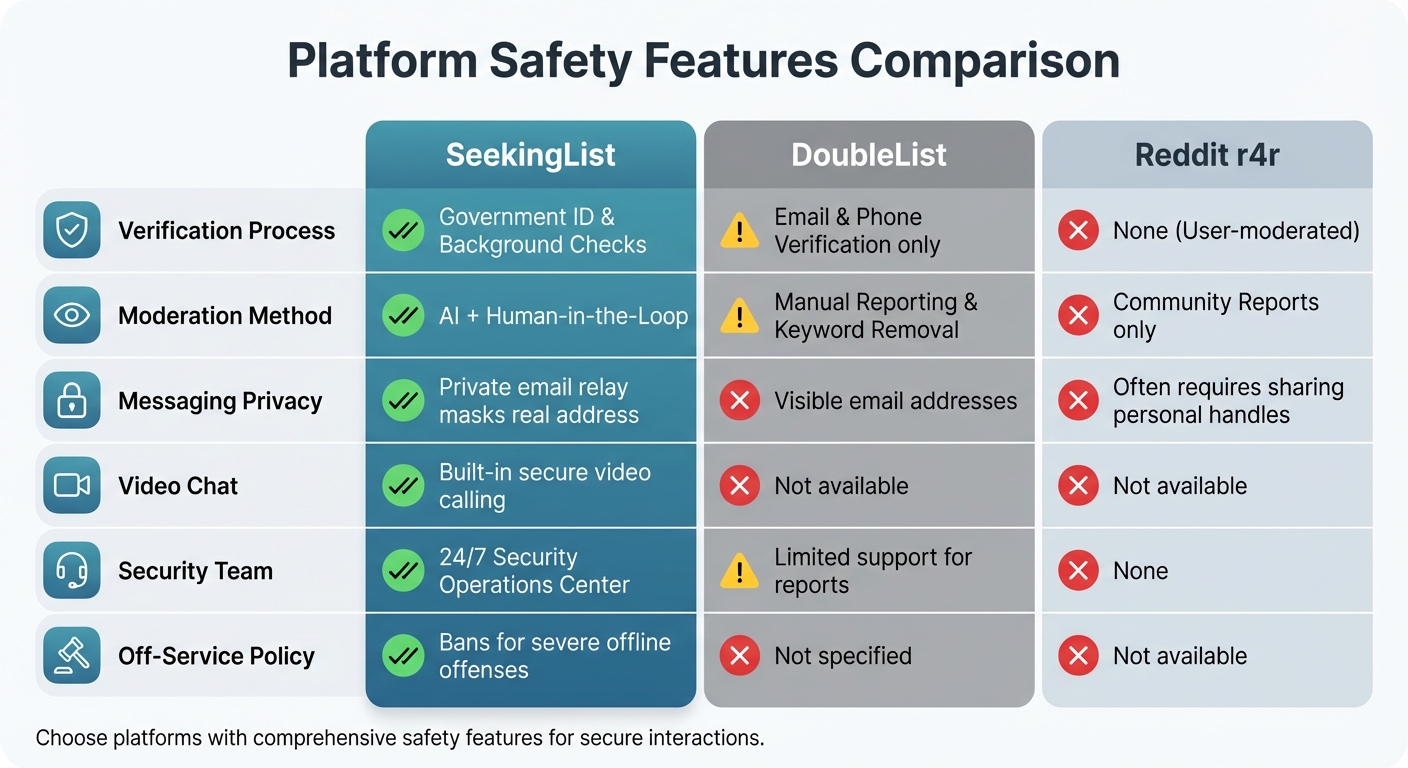
SeekingList’s safety features go beyond what most other classifieds platforms offer. Here’s how it compares:
| Feature | SeekingList | DoubleList | Reddit r4r |
|---|---|---|---|
| Verification Process | Government ID & Background Checks | Email & Phone Verification | None (User-moderated) |
| Moderation Method | AI + Human-in-the-Loop | Manual Reporting & Keyword Removal | Community Reports |
| Messaging Privacy | Private email relay masks real address | Visible email addresses | Often requires sharing personal handles |
| Video Chat | Built-in secure video calling | Not available | Not available |
| Security Team | 24/7 Security Operations Center | Limited support for reports | None |
| Off-Service Policy | Bans for severe offline offenses | Not specified | Not available |
Unlike DoubleList, which relies on user reports and exposes your email during messaging, SeekingList keeps your contact information private and actively scans for potential threats. And while Reddit r4r lacks formal verification, a security team, or privacy tools, SeekingList offers optional ID and background check badges, helping you connect with users you can trust.
Conclusion: Safe and Successful Classifieds Meetings
Meeting through classifieds can be safe if you take the right steps. Start by verifying profiles through ID and background check badges, keep your conversations on the platform to safeguard your personal details, and always choose public places for first meetings. Let a trusted friend know your plans, arrange your own transportation, and trust your gut - if something feels off, it probably is. These habits, combined with SeekingList’s tools, create a safer environment for your interactions.
SeekingList blends personal safety practices with platform-specific protections. Features like private email relay ensure your contact details remain hidden, while AI-driven moderation works to detect and block fraudulent activity. As Seeking highlights:
Your personal safety is Seeking's primary focus. It should be yours as well.
This sets SeekingList apart from platforms like DoubleList, which displays your email during messaging, or Reddit r4r, which lacks verification and a dedicated security team. SeekingList provides robust security measures, including SSL certification, web application firewalls, and a 24/7 Security Operations Center.
FAQs
How can I verify someone is real without sharing my number?
To confirm someone's identity without sharing your phone number, take advantage of tools like video chat offered by the platform. This allows you to verify their identity in real time. You can also ask for additional photos or a live video to see if they align with their profile. Be wary of anyone who seems hesitant or avoids verification - it could be a red flag. Keep your personal contact details private until you're confident, and rely on the platform's safety features to help maintain your privacy.
What should I do if someone asks me for money or gift cards?
Requests for money or gift cards are a major warning sign of scams, especially in romance scams. Avoid sending money, sharing your financial information, or providing gift cards under any circumstances. Take steps to verify the person's identity and their intentions if something feels off. If you suspect suspicious behavior, report it to the platform or relevant authorities. Staying alert and careful can go a long way in protecting yourself from fraud.
What’s the safest way to leave if a first meet-up feels wrong?
The safest way to wrap up a first meet-up is to trust your gut and have a clear exit plan in place. If something doesn’t feel right, don’t hesitate - leave immediately. Always choose a public location for the meeting, and make sure a friend or family member is aware of your plans ahead of time. Share details like where you’ll be and when you expect to return so they can check in on you. These simple steps can provide peace of mind and ensure you have a safe way out if things take an uncomfortable turn.